
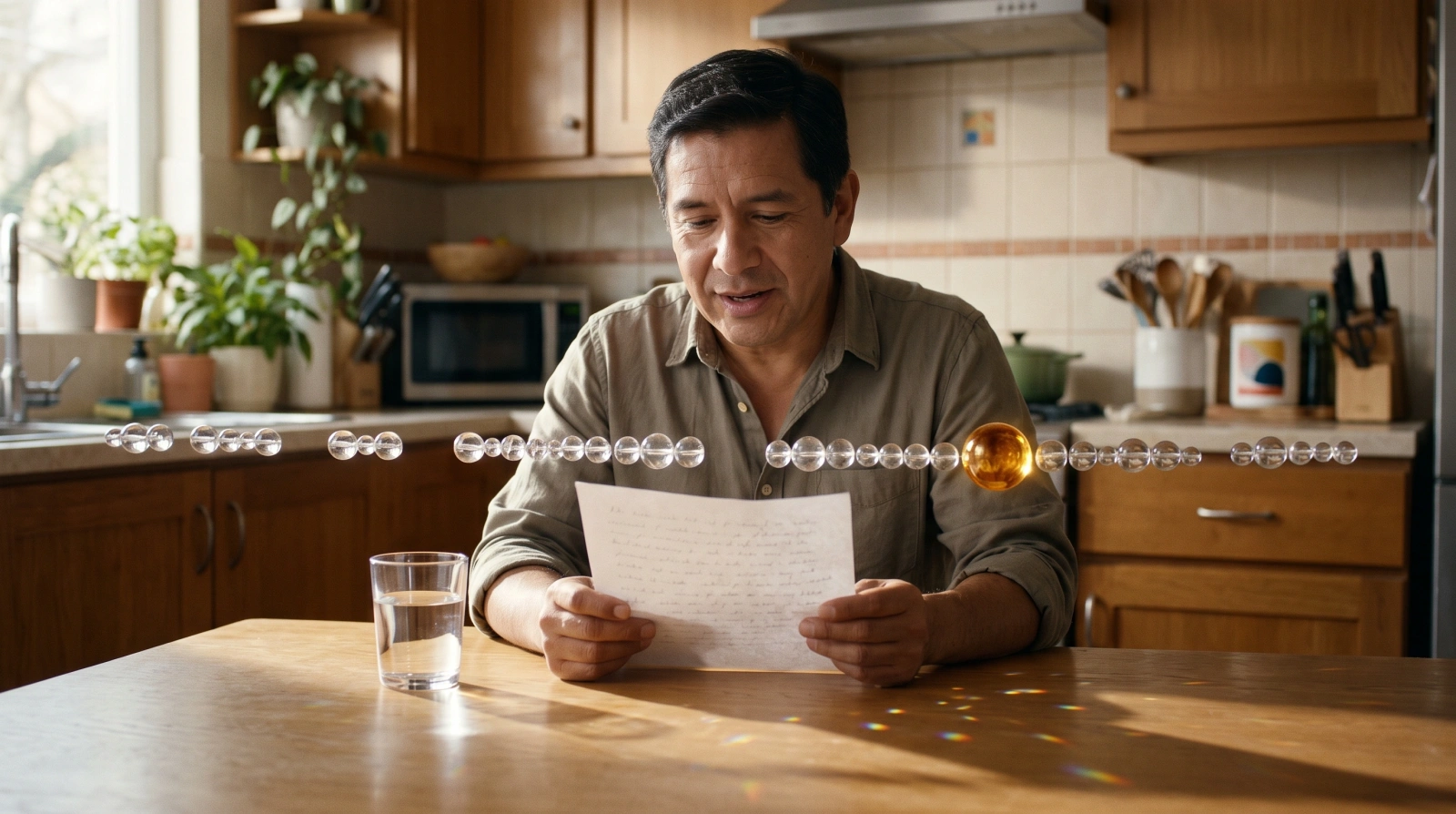
You wrote a script you like. On paper it reads well.
You read it out loud at the kitchen table, and it sounds like someone reading a contract. Every sentence has the same length, the same tone and no pause.
What was missing was deciding how each sentence is said.
The same sentence, three meanings
Read this question three times and stress a different word each time:
"You paid for that?" (you of all people, who never spends)
"You paid for that?" (it was not a gift)
"You paid for that?" (that thing, and not another)
They are the same words. The stressed word changes what the listener understands. In a video it works the same way: if the voice stresses the wrong word, the message gets lost.
Emotion needs a cause
Writing "excited" or "happy" next to a line gives nobody any emotion. The voice sounds forced, and the listener notices even if they can't say why.
What works is saying what happened. "I opened the box and the color was exactly the one in the photo" already carries the joy inside, and the voice follows it on its own.
The rhythm of a person talking
A real person does not talk in sentences of the same length. Three things help:
- short and long sentences mixed;
- a short pause before the last sentence;
- the brand name said a little slower.
And one rule about quantity: each shot lasts a few seconds, and only a few words fit in those seconds. If you put in too many, the voice rushes or gets cut off. And the tone has to be the same in every shot: if one is fast and the next is slow, the cut shows and it sounds like another person.
What you take from this page
Before you approve a script, read it out loud one more time and mark in each sentence:
- the word said most strongly;
- where the pause goes;
- what happened that explains how the speaker feels.